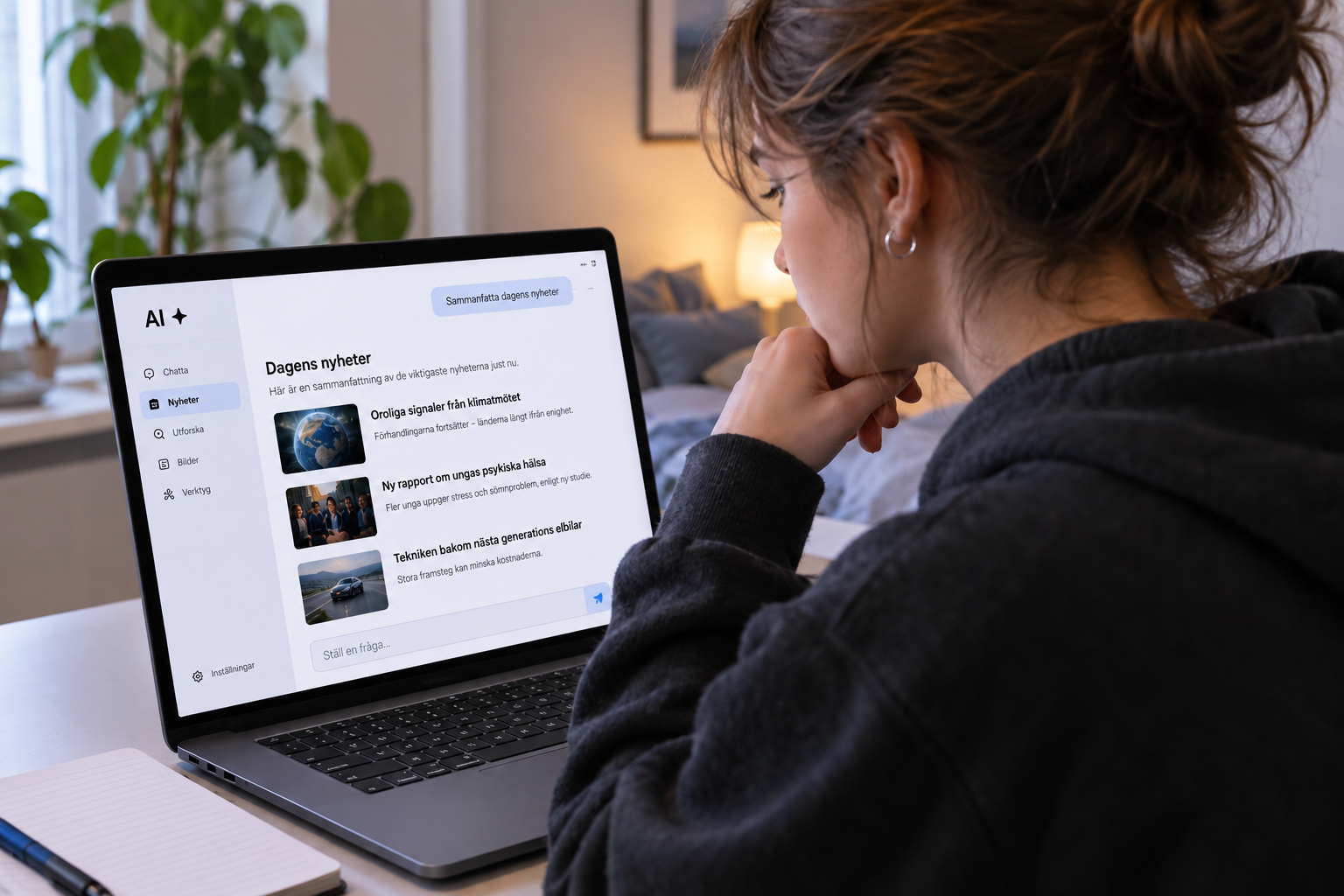
Where do you get your news in the morning? From DN, SVT or Omni? From your feed on Instagram, TikTok or LinkedIn? Or do you ask ChatGPT what’s happened?
Asking ChatGPT is still a fairly unusual way to get the news. It’s more common than you might think, though, and it’s growing quickly. According to the Reuters Institute’s Digital News Report 2026, 10% of respondents use AI tools such as ChatGPT, Gemini or Claude for news at least once a week. The previous year, the figure was 7%.
In Sweden, usage is slightly lower, but the increase is more striking. Seven per cent of Swedes now use AI chatbots for news every week, up from 3% a year earlier. The share has more than doubled in a year.
As with many things involving AI, usage is considerably higher among younger people. In the Reuters Institute survey, 17% of the youngest age group, those aged 18 to 24, use AI chatbots for news. Among the oldest group, the figure is 5%.
There’s reason to be careful about reading too much into the figures. Only 1% still say AI is their main source of news. For the vast majority, ChatGPT and similar services offer another way to find and understand information alongside journalism and other news sources. The Reuters Institute describes the growth as fast rather than explosive.
There’s an even more interesting finding in the survey. It’s easy to see AI as another step towards shallower news consumption. First we read the newspaper, then articles online, then headlines on social media, and now we ask AI to sum it all up for us. The figures tell a different story.
Among people who use AI chatbots for news, 38% belong to the group the Reuters Institute calls “news lovers”, compared with 22% of respondents overall. The report describes them as power news consumers who follow a wide range of sources in different formats and actively seek out information. AI seems to appeal particularly to people who already consume a lot of news and are adding another tool to get even more out of it.
That becomes clearer when you look at what people actually do with AI. The most common use is asking follow-up questions, which 42% of people who use AI for news say they do. In other words, they’re digging deeper.
That’s a significant change from how we’ve traditionally consumed news. If you read an article about Sweden’s central bank changing its policy rate, you get the explanation the journalist and editors have chosen to give you. With an AI tool, you can keep asking why the Riksbank made that decision, what it means for your mortgage, how Sweden differs from the rest of Europe, or which economists disagree with the decision and why. The news story becomes the beginning of a conversation.
At the same time, 35% simply use AI to get the latest news, 34% use it to summarise stories and 30% use it to get a simpler explanation. In these cases, people seem to be looking for a quick update or some straightforward background.
The Reuters Institute also asked people why they use AI for news. The most common answer was that they wanted more depth or a better explanation. Other common reasons included getting a quick summary of a complicated story and pulling together information from several news sources. Again, it seems people want to know more or make sense of something they find difficult to understand.
I can see the same shift in my own news habits. Every morning at 6.30, I get an AI-generated briefing on the most important stories from the past 24 hours. I’ve decided what goes into it. I’m not particularly interested in sports news, for example, so I’ve left it out.
The summary itself is hardly the most interesting part. If a story catches my attention, I can immediately ask for the background, find out why something happened or compare different perspectives. In fact, I do exactly that every other day or so.
That’s where the difference from a conventional news briefing becomes clear. I get a summary of what happened over the past day and a way to keep exploring it.
There are, of course, problems with this development. AI can give incorrect answers, miss important perspectives or sound overly certain about something that’s still unclear. At the same time, AI is getting better all the time. In a typical week, 87% of people in Sweden use online news sources and 47% get news through social media, while AI is still at 7%. Established news channels remain firmly in place. Major news outlets may have little reason yet to rethink how they’ll charge for news in the future, though they’ll probably have to start thinking about it soon.
Getting news through AI adds another layer on top of the existing media. And that layer works differently. Once we’ve read what happened, we can keep asking questions. Why did it happen? What does it mean? Who sees it differently? What’s the background?
There’s a paradox here. AI makes it possible to get through the news faster and stop at a short summary. For anyone who’s genuinely interested, the same technology makes it much easier to go deeper. Which of those two habits will dominate in five years? It’s probably too early to say.
Michael Falk