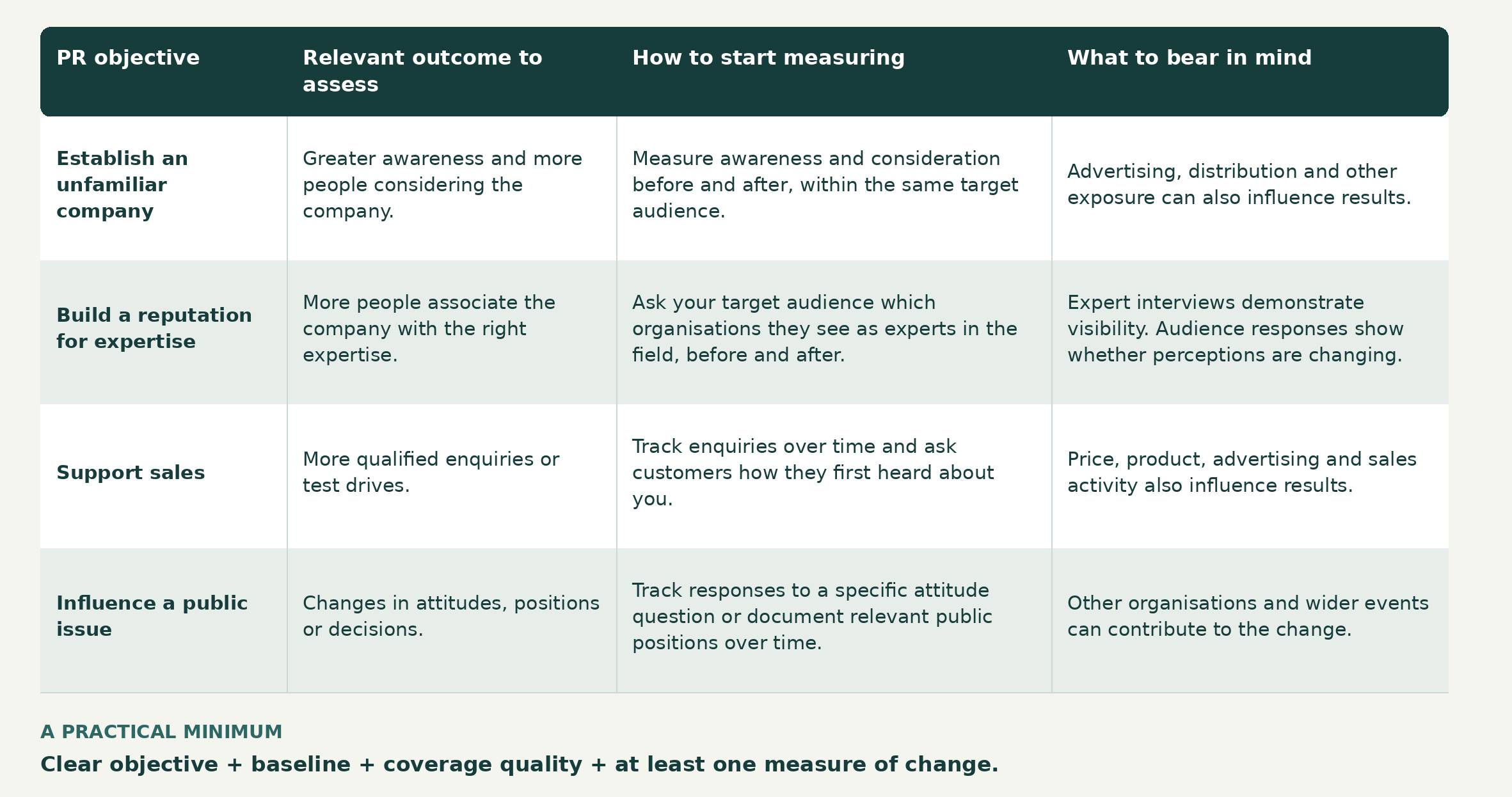
PR can help more people become aware of a company, build greater confidence in its expertise or encourage them to get in touch. To know whether the work is having the desired effect, measurement needs to start with the change we want to achieve. A clear objective and a few well-chosen measures are usually a good starting point!
Start with what your target audience should know, think or do
Before starting a PR campaign, it helps to ask this very simple question: What do we want to have changed once the work has been under way for a while? For a company entering a new market, the answer might be that more potential customers should know the brand. For another company, it could be about being associated with the right things, such as a particular area of expertise or type of product. Or the objective might be to generate more incoming enquiries.
The answer helps us choose both our activities and our measures. If the objective is to build trust, we naturally need to examine how the target audience perceives the company. If the aim is to support sales, we also need to be able to track what is happening within the sales organisation.
Track both coverage and change
In media relations, for example, coverage is an important result, but the number of articles is only part of the picture. We also need to look at which outlets we reach, how relevant they are to the target audience and whether the things the company wants to be known for actually come across. An article in which the company’s expert explains an important topic might seem like a major success. But if the challenge is simply to build brand awareness, a brief mention that reaches exactly the right audience might be even better.
The next level, which unfortunately costs more and requires more work from the PR agency, is to examine what is changing among the target audience. Have more people heard of you? Do more people associate you with the expertise you want to highlight? Are you receiving more relevant enquiries? In short, media monitoring shows the coverage the work has generated, while audience research and business data help you assess what that coverage contributes to.
Even precise figures need interpretation
Digital advertising often provides a clearer link between publishing, clicks and purchases. Clicks and completed purchases provide valuable information, but do not automatically tell us how much difference the ad made. The customer may already have decided to buy, perhaps after a recommendation from a friend or a newspaper article. In that case, the purchase would have happened even without the ad!
To get a better understanding of the ad’s actual effect, we could, for example, compare results with a group that was not shown the ads. Otherwise, we do not know what the figures in one of the usual campaign reports actually tell us about effectiveness. The same fundamental question applies to both PR and advertising: What would have happened if we had not carried out the activity?
Measurements must be possible to understand
Effectiveness measurement also comes with plenty of terminology that, frankly, most people do not fully understand. Reach, engagement, conversion, attribution and incremental impact describe different things. Yet in a report, they can easily come across as different words that all mean the same thing: success. These terms can be useful, but only if we understand what they show and what conclusions they allow us to draw.
Evaluation simply needs to be understandable even to someone who does not work with measurement every day. What did we want to change? What can we see has changed? And how confident are we that our work contributed? If we can answer these questions, we can make the next marketing or PR activity more effective.